
What Is Refurbishment Bridging Finance?
Refurbishment bridging finance is a short-term, property-backed facility that covers both the purchase of a property and the cost of renovating it. It solves a fundamental problem in property investment: the properties with the greatest value-add potential are often the ones that mainstream mortgage lenders refuse to touch.
Standard mortgage lenders require properties to be in a habitable condition - functioning kitchen, bathroom, heating, and weathertight structure. Properties that fail these criteria are unmortgageable through conventional channels, yet they represent some of the best investment opportunities available. A refurbishment bridging facility funds the acquisition, holds the property during the renovation period, and exits once the improved property qualifies for conventional long-term finance.
The value-add principle is straightforward: acquire below market value, invest in improvements, and exit at the enhanced value - creating equity through the renovation process rather than simply through market appreciation.
For the fundamentals of how bridging facilities work, see our guide on what a bridging loan is.
Light vs Heavy Refurbishment
The distinction between light and heavy refurbishment is important because it affects the loan structure, terms, pricing, and the level of information lenders require.
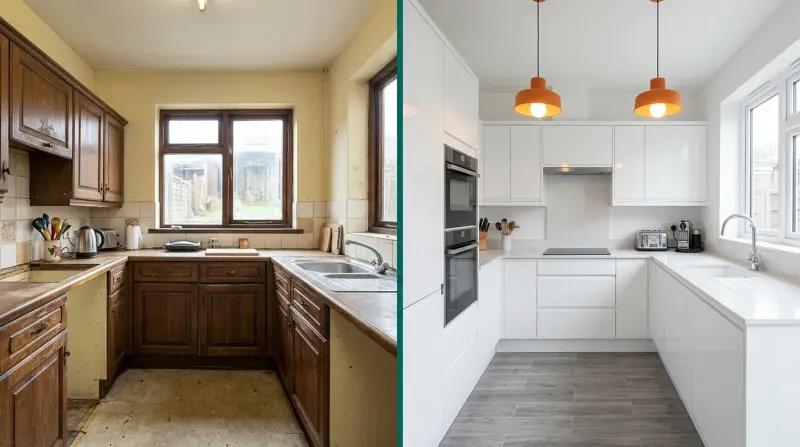
- Light Refurbishment: Cosmetic and minor works that do not alter the property's structure or require planning permission. Typical works include new kitchens and bathrooms, full redecoration, updated flooring, garden landscaping, new boiler installation, and basic repairs. Timeline: 3-6 months. Suited to: properties that are tired but structurally sound.
- Heavy Refurbishment: Structural alterations, extensions, conversions, or works requiring planning permission and building regulations approval. Typical works include removing or adding internal walls, loft conversions, rear extensions, underpinning, rewiring, replumbing, and change-of-use conversions. Timeline: 6-12 months. Suited to: properties requiring significant transformation to unlock their value.
Light refurbishment is the more accessible entry point for investors. The works are faster, the costs are lower, and the risk profile is simpler for lenders to assess. Heavy refurbishment requires more planning, larger budgets, and often a track record or experienced professional team - but the value uplift can be substantially greater.
For projects that cross into full-scale conversion or new-build territory, our development finance guide covers the options available for larger-scope schemes.
The Buy-Refurbish-Refinance Strategy
The buy-refurbish-refinance (BRR) model is one of the most popular strategies among portfolio landlords and property investors. A refurbishment bridging facility is the financial engine that powers it.
The process follows four steps:
- Buy - acquire the property using bridging finance, typically at below-market value because of its condition
- Refurbish - complete the renovation works to bring the property to a lettable or saleable standard
- Let - if retaining the property, place tenants to establish rental income
- Refinance - remortgage onto a standard buy-to-let mortgage based on the improved post-works value
The critical mechanism is the value uplift. For example, if a property is purchased for £120,000, refurbished for £30,000, and revalued at £200,000, the investor could refinance at a typical LTV of around 75% (£150,000) - recovering their entire initial outlay and retaining the property with equity built in.
This strategy allows investors to recycle capital repeatedly, growing a portfolio without injecting fresh funds for each acquisition. Our buy-to-let refurbishment case study demonstrates this approach in practice. For more on how bridging supports buy-to-let investment, see our BTL bridging guide.
Property Types Suited to Refurbishment Finance
Auction Properties
Properties sold at auction are frequently in need of refurbishment - and often priced to reflect this. The 28-day completion deadline at auction aligns naturally with bridging finance, and the below-market-value purchase price creates the margin for profitable refurbishment.
See our guide to auction property finance for detailed coverage of the auction purchase process.
Repossessions and Estate Sales
Properties sold following repossession or through estate clearances are often in poor condition. Vendors are motivated by speed and certainty rather than price, creating opportunities for investors who can complete quickly and invest in renovation.
Former Commercial Premises
Change-of-use conversions - turning disused offices, retail units, or industrial buildings into residential accommodation - can deliver significant value uplift. These projects often qualify under permitted development rights, avoiding the full planning application process.
Properties with Building Defects
Properties with structural issues, subsidence, damp, or non-standard construction are frequently declined by mainstream mortgage lenders. A bridging facility funds the purchase and the remedial works, and the property becomes mortgageable once the defects are resolved.
HMO Conversions
Converting a standard house into a House in Multiple Occupation (HMO) for multi-tenant rental income is a popular strategy for maximising rental yield. The works typically involve adding bathrooms, creating self-contained rooms, and upgrading fire safety - a combination of light and heavy refurbishment that bridging finance supports.
Loan Structure and Terms
Amounts
Refurbishment bridging facilities from Mallard Bridging range from £25,250 to £40,000,000, covering both the property purchase and the works budget within a single facility.
Terms
Light refurbishment facilities typically run for 3 to 9 months, reflecting the shorter works programme. Heavy refurbishment and conversion projects sit at the upper end of Mallard Bridging's 12-month maximum term. The term is matched to the realistic project timeline plus a contingency buffer for unexpected delays.
Staged Drawdowns for Works Costs
For larger refurbishment projects, the works element of the facility may be released in stages rather than as a single advance. Staged drawdowns reduce the interest cost to the borrower (interest only accrues on funds drawn) and provide the lender with confirmation that works are progressing as planned.
The drawdown stages are agreed at the outset and typically align with key milestones - first fix, second fix, completion. Evidence of progress may be required before each release.
Pricing
All costs are rolled into the gross loan amount - setup fees, legal fees, valuation costs, and interest. There are no monthly payments, no separate invoices, and no exit fees. Borrowers who repay on or before the agreed date receive a timely repayment discount.
For a full breakdown of how bridging pricing works, see our costs and fees guide.
Ready to Discuss Your Refurbishment Project?
Our bridging finance specialists are available Monday-Friday, 9:00 AM - 5:30 PM.
Exit Strategies
Refinance Onto a Long-Term Mortgage
The most common exit for refurbishment bridging. Once the works are complete and the property is in mortgageable condition, the borrower refinances onto a standard residential or buy-to-let mortgage based on the improved value. The refinance proceeds repay the bridging facility.
This route works best when the post-works valuation supports sufficient LTV to cover the outstanding bridging balance. Realistic assessment of the post-works value at the outset is essential.
Property Sale
Borrowers who refurbish properties for resale rather than retention exit by selling the completed property. The sale proceeds repay the bridging facility, and the profit is the difference between the total project cost (acquisition + works + finance costs) and the sale price.
This model is common among professional property traders who buy, renovate, and sell on a regular basis.
Portfolio Refinance
Investors holding multiple properties may use a portfolio refinance to consolidate several properties under a single long-term facility, repaying multiple bridging loans simultaneously.
For detailed guidance on structuring exits, see our exit strategy guide.
Managing Refurbishment Risk
Every refurbishment project carries risk. Identifying and mitigating these risks before committing to a project is essential.
- Build cost overruns - unforeseen issues behind walls, under floors, or in roof spaces can add significantly to the original budget. Many renovators budget a contingency of at least 10-15%
- Timeline delays - material supply issues, contractor availability, weather, and the discovery of hidden defects can extend the programme beyond initial estimates
- Post-works valuation shortfall - the improved property may not achieve the projected value if the refurbishment specification doesn't match local market expectations
- Contractor reliability - contractor insolvency, quality issues, or disputes can stall a project and increase costs
- Planning and building regulations - unexpected requirements from the local authority or building control can add time and cost to heavier schemes
Practical Mitigation Steps
Experienced renovators manage these risks through:
- Thorough pre-purchase surveys - understanding the property's condition before committing reduces the likelihood of expensive surprises
- Realistic budgets with contingency - a sensible contingency buffer absorbs typical cost increases without threatening the project viability
- Fixed-price contracts where possible - agreeing a fixed price with the contractor transfers cost-overrun risk
- Phased project management - breaking the works into stages with clear sign-off points allows issues to be identified and addressed early
- Working with experienced tradespeople - proven contractors with references reduce the risk of quality issues and delays
Common Scenarios
Landlord Upgrading a Tired Buy-to-Let
A landlord owns a rental property that has been let for fifteen years without significant updating. The kitchen and bathroom are dated, the electrics need upgrading, and the rental yield has fallen behind comparable properties in the area. A refurbishment bridging facility refinances the existing mortgage and provides additional funds for a complete renovation. Once the works are complete, the property is re-let at a significantly higher rent and refinanced onto a new buy-to-let mortgage based on the improved value.
Investor Buying at Auction Below Market Value
An investor purchases a three-bedroom terraced house at auction for £95,000 - well below the estimated post-works value of £150,000. The property needs a full cosmetic renovation: new kitchen, bathroom, decoration, flooring, and garden. A bridging facility funds the purchase and the £25,000 works budget. Six months later, the completed property is refinanced at a standard LTV (for example, £112,500 at 75%), recovering the majority of the investor's capital.
Converting a Commercial Unit to Residential
A former ground-floor retail unit with a residential upper floor is purchased using bridging finance. The ground floor is converted to a two-bedroom flat under permitted development rights, creating a two-unit residential property from a single commercial asset. The works take nine months, and the completed building is refinanced onto buy-to-let mortgages at a valuation reflecting the residential use.
For borrowers using limited company structures for their property investments, refurbishment bridging integrates naturally with SPV ownership - the standard structure for tax-efficient property portfolio management.
The Application Process
Refurbishment bridging applications require information about both the property and the planned works.
What to prepare:
- Property details and current condition
- Purchase price or current value
- Schedule of works with costings
- Projected post-works value supported by comparable evidence
- Exit strategy and timeline
- Planning status (for heavy refurbishment requiring consent)
- Developer experience (for heavier schemes)
- Contractor details (for heavy refurbishment)
For a step-by-step walkthrough of the general bridging process, see our guide on how bridging loans work.
Frequently Asked Questions
What is the difference between light and heavy refurbishment finance?
Light refurbishment covers cosmetic works without structural changes or planning permission - typically 3-6 months of works such as new kitchens, bathrooms, and redecoration. Heavy refurbishment involves structural alterations, extensions, conversions, or works requiring planning permission, typically 6-12 months.
Can refurbishment costs be included in the bridging loan?
Yes. A single facility can cover both the property purchase and the refurbishment budget. Works funds may be released in stages as the project progresses, subject to assessment.
What exit strategy works for refurbishment bridging?
The most common exit is refinancing onto a standard mortgage based on the improved post-works value. Alternatively, borrowers sell the refurbished property. Both routes benefit from the uplift in value that successful refurbishment delivers.
Do I need building experience to get refurbishment finance?
Not necessarily for light refurbishment. For heavy refurbishment and conversion projects, lenders assess the borrower's experience and the professional team involved. First-time developers with experienced contractors and project managers can still access finance.
How is LTV calculated on refurbishment projects?
The initial advance is typically based on the current property value or purchase price. Lenders also consider the projected post-works value when assessing the exit strategy, and additional funds may be released as works progress and value increases.