
When a property deal has a hard deadline, traditional bank lending cannot keep pace. Committee-based approvals and sequential processing queues mean weeks or months of waiting - time that most business borrowers simply do not have.
Mallard Bridging was built for speed. Repeat clients with details already on file could have funds in as fast as 24 hours. Prepared new borrowers with complete documentation can achieve funding within 48 hours for straightforward first charge deals. All timelines are subject to satisfactory valuation, documentation, and legal process.
This guide explains what rapid property finance looks like in practice, what determines whether your deal completes in days or weeks, and how to prepare so nothing slows you down.
What Fast Bridging Finance Really Means
The phrase "fast finance" appears across hundreds of lender websites, but the definition varies wildly. Some lenders mean fast initial quotes. Others mean fast credit decisions with slow legal processes. A genuinely fast facility means the entire journey - from first contact through legal work to funds landing in your solicitor's account - happens within a compressed timeline.
At Mallard Bridging, we define speed across three distinct stages:
Initial assessment and decision in principle For straightforward enquiries, we provide a quote on the same business day, often within hours of receiving your details. This tells you whether the deal is viable before you invest time in the full application.
Full credit approval Once we have your supporting documentation, formal approval typically follows within one to two working days for uncomplicated first charge cases. More complex structures may require an additional day or two.
Legal completion and funds release This is where many lenders lose time. With responsive solicitors and clean title, funds can be released within three to five working days of approval. In exceptional circumstances - unencumbered property with no existing charges, clear title, and a solicitor ready to act immediately - completion has been achieved within twenty-four hours.
If you are new to this type of finance, our guide on what a bridging loan is covers the fundamentals before diving into speed-specific considerations.
Realistic Funding Timelines
Honesty about timelines matters more than optimistic promises. All timelines are subject to satisfactory property valuation, documentation, and legal process. Different deal structures carry different completion speeds, and understanding where your situation falls helps you plan accurately.
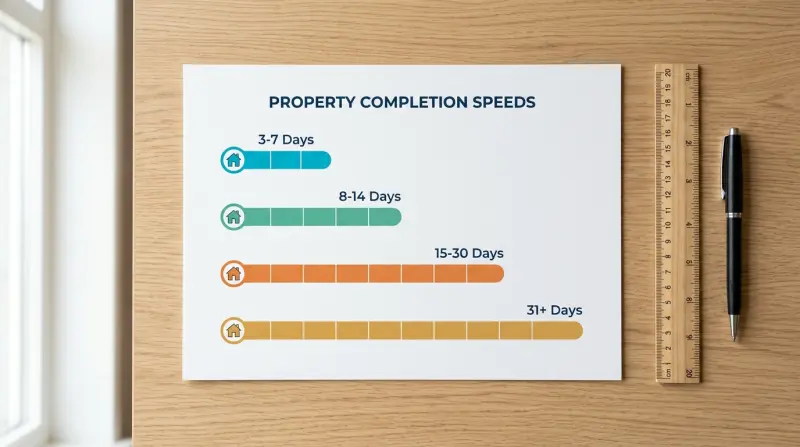
First Charge, Simple Structure: 24 Hours to 48 Hours
The fastest completions share common characteristics:
- Single property security with clean, registered title
- No existing mortgage or charge to discharge
- Individual or simple company borrower
- Clear, documented exit strategy
- Solicitor instructed and ready to act
- Valuation straightforward (standard residential or commercial property)
These deals move quickly because there is no third-party lender to consult, no complex ownership structure to verify, and no chain of consents to obtain. For repeat clients with details already on file, funds can be released in as fast as 24 hours. Prepared new borrowers with complete documentation can achieve funding within 48 hours. All timelines are subject to satisfactory valuation, documentation, and legal process.
First Charge with Existing Mortgage to Discharge: 5-10 Working Days
When the security property carries an existing mortgage that will be repaid from bridging funds, the process adds a few steps. The existing lender must provide a redemption statement, and the solicitor must handle both the discharge and the new charge simultaneously. This is routine work, but it adds time.
Second Charge Behind Existing Mortgage: 7-14 Working Days
Second charge facilities sit behind an existing mortgage, so the first charge lender's consent forms part of the process. We request this at the outset and run it alongside the valuation and legal work rather than in sequence. Where the existing lender responds promptly, completion sits comfortably within the timeframe above.
Complex Structures: 10-21 Working Days
Deals involving multiple security properties, corporate SPV structures, properties held in trust, or cross-charges against different entities require additional legal work. Each additional layer of complexity adds time for due diligence, documentation, and verification.
What Speeds Up Completion
Certain factors consistently accelerate the lending process. If speed is your priority, optimising these elements before you apply makes a measurable difference.
Clean, Registered Title
Property with a straightforward, registered title at HM Land Registry allows solicitors to complete their checks rapidly. Unregistered land, disputed boundaries, or missing title documents create delays that no amount of urgency can overcome.
Responsive Solicitors
Legal work is often the longest stage of any bridging transaction. A solicitor experienced in bridging finance who treats your instruction as a priority can shave days off the timeline. Many borrowers find it beneficial to use a solicitor familiar with fast-turnaround property finance - they understand the documentation requirements and can anticipate what the lender needs.
Complete Documentation from Day One
Submitting a full, accurate application with all supporting documents at the outset eliminates back-and-forth requests. Every document request that requires a follow-up email adds at least a day to the process. We provide a detailed checklist (covered below) so you know exactly what is needed.
Unencumbered Property
Property with no existing charges, mortgages, or legal restrictions completes fastest. There are no third parties to notify, no consents to obtain, and no redemption figures to wait for.
First Charge Position
Taking a first legal charge over the security property is simpler than arranging a second charge. No existing lender consent is required, and the legal documentation is more straightforward.
Pre-Arranged Valuation
If you can provide a recent valuation or have one commissioned before applying, this removes one of the common waiting points. Desktop valuations can be arranged within hours for certain property types, while physical inspections typically require a few days' notice.
What Slows Things Down
Understanding potential delays helps you avoid them or at least plan around them.
Second Charge Lender Consent
Where a deal involves a second charge, the existing first charge lender's consent is part of the picture. Some lenders turn these requests around quickly; others take longer. Many borrowers find that flagging a likely second charge to their existing lender early, so the request is already in motion, keeps this from adding time.
Complex or Defective Title
Properties with historical title issues, missing deeds, boundary disputes, restrictive covenants requiring investigation, or rights of way that need clarification all extend the legal process. Title indemnity insurance can sometimes resolve minor issues quickly, but significant defects require proper resolution.
Corporate and Trust Structures
Lending to companies, LLPs, or trusts requires additional due diligence. Company searches, confirmation of authorised signatories, trust deed review, and beneficial ownership verification all take time. If you are borrowing through a corporate vehicle, having your company documents organised and readily available helps.
Multiple Security Properties
Cross-charging multiple properties increases the legal workload proportionally. Each property needs its own title check, valuation, and charge registration. If properties are held by different entities or in different jurisdictions, complexity increases further.
Incomplete or Inconsistent Information
Applications that arrive with missing information, inconsistent figures, or unclear exit strategies generate queries. Each query requires a response, and each response takes time. A clean, complete application is the single most effective way to maintain momentum.
Property Access Issues
If a physical valuation is required and the property is difficult to access - tenanted with uncooperative occupants, remote location, or restricted access hours - arranging the inspection takes longer. Facilitating prompt access speeds up this stage significantly.
Urgent Scenarios Where Speed Is Critical
Certain business situations demand rapid funding because the consequences of delay are severe. These are the scenarios where fast bridging finance delivers genuine, measurable value.
Auction Purchases: The 28-Day Deadline
When you win a property at auction, you exchange contracts on the day and must complete within 28 calendar days. Miss the deadline and you lose your 10% deposit, face potential legal action from the seller, and forfeit the opportunity entirely.
Auction property finance is one of the most common reasons businesses seek rapid bridging. Pre-approval before auction day is the ideal approach, but even post-auction applications can complete well within the required window when the deal fundamentals are sound.
Our fastest auction-related completion moved from initial enquiry to funds released in under twenty-four hours - a £60,000 facility secured against unencumbered property where the borrower had all documentation ready and the solicitor acted immediately.
HMRC Enforcement Deadlines
Tax obligations do not wait for traditional bank lending timelines. When HMRC issues enforcement action or sets a payment deadline, the consequences of missing it can include penalties, interest charges, county court judgments, or even winding-up petitions against your business.
Property-backed lending allows business owners to meet tax deadlines by releasing equity from investment or commercial property. The exit strategy is typically refinancing onto longer-term finance or selling a property asset once the immediate pressure is resolved.
Time-Limited Business Opportunities
Bulk stock at a significant discount, a competitor's client book available for acquisition, or a commercial premises that will not stay on the market - some opportunities have natural expiry dates. Traditional lending cannot move fast enough to capture them.
Interim property funding bridges the gap between the opportunity appearing and longer-term finance being arranged. The speed of deployment means you can act decisively while competitors wait for bank approval.
Expiring Purchase Contracts
Property purchase contracts often include longstop dates. If your intended funding falls through or your buyer withdraws from a linked sale, you need replacement finance quickly or risk losing the property, your deposit, and potentially facing a breach of contract claim.
Chain break bridging loans can step in as emergency replacement finance, completing in days rather than the weeks or months a new mortgage application would require.
Supplier and Creditor Payment Deadlines
Critical supplier relationships, threatened legal action from creditors, or payment deadlines that will trigger default clauses in commercial agreements all create genuine urgency. Business cashflow lending provides the working capital needed to meet these obligations while longer-term solutions are arranged.
Development Site Acquisition
Development plots and sites attract intense competition. Vendors and agents favour buyers who can demonstrate speed and certainty of funding. Being able to complete a purchase within days gives you a significant competitive advantage over buyers reliant on traditional development finance, which typically takes four to six weeks to arrange.
What to Prepare Before Applying
Having your documentation ready before you make contact is the single most effective way to ensure rapid completion. The following checklist covers what we need to assess and approve your application.
Borrower Information
- Identification: Passport or driving licence for all applicants and guarantors
- Proof of address: Utility bill or bank statement dated within three months
- Company documents (if applicable): Certificate of incorporation, memorandum and articles of association, confirmation statement, details of directors and shareholders
- Asset and liability statement: Summary of properties owned, outstanding mortgages, and other significant financial commitments
Property Information
- Full address and description of the security property
- Title number (available from HM Land Registry)
- Current mortgage details (if any): lender name, account number, approximate outstanding balance
- Recent valuation (if available): Desktop valuation, estate agent appraisal, or comparable evidence
- Tenancy information (if applicable): current tenants, lease terms, rental income
- Planning information (if relevant): existing permissions, pending applications
Deal Information
- Loan amount required and purpose of funds
- Exit strategy: How and when you will repay the loan. Common exits include property sale, refinancing onto a term mortgage, or business income. The clearer and more evidenced your exit strategy, the faster the approval process.
- Timeline: When you need funds and any hard deadlines
- Solicitor details: Name, firm, and contact details for your instructed solicitor
Supporting Evidence
- Proof of deposit or equity (where relevant)
- Evidence supporting your exit strategy: mortgage agreement in principle, marketing particulars, or business projections
- Source of funds declaration for any cash contribution

Ready to Discuss Your Fast Bridging Requirements?
Our bridging finance specialists are available Monday-Friday, 9:00 AM - 5:30 PM.
How the Rapid Assessment Process Works at Mallard Bridging
Our process is designed to eliminate unnecessary steps while maintaining thorough risk assessment. Here is what happens when you contact us with an urgent requirement.
Stage 1: Initial Conversation
You contact us by phone on 0161 883 3708, by email at contact@mallardbridging.co.uk, or by booking a callback at a time that suits you. We gather the essential details of your requirement: loan amount, property details, timeline, and exit strategy.
For urgent cases, a phone call is the fastest route. We can assess viability during the initial conversation and tell you immediately whether the deal fits our criteria.
Stage 2: Decision in Principle
Based on the initial information, we provide a decision in principle outlining the quote, including the facility amount, rate indication, fee structure, and estimated timeline. This typically happens within hours of first contact.
Stage 3: Documentation and Valuation
Once you confirm you wish to proceed, we request the full documentation package outlined above. Simultaneously, we arrange the property valuation. Running these processes in parallel rather than sequentially saves valuable time.
Stage 4: Full Credit Approval
With documentation reviewed, valuation received, and all queries resolved, we issue a formal facility offer. For clean first charge deals with complete documentation, this stage is completed within one to two working days.
Stage 5: Legal Work and Completion
Our solicitors are instructed immediately upon approval. They work to an expedited timeline, prioritising searches, title verification, and charge registration. For the fastest completions, we use solicitors experienced in urgent bridging transactions who understand the importance of same-day turnaround on their side.
Funds are released to your solicitor's client account as soon as all legal conditions are satisfied.
Understanding the full process
For a detailed walkthrough of every stage, our guide on how bridging loans work explains the complete journey from application through to repayment, including what happens at each step and what is expected of you as the borrower.
Bridging Speed vs Bank Lending Speed
The speed difference between bridging finance and traditional bank lending is not marginal - it is transformational. Here is a realistic comparison based on typical UK lending timescales.
Traditional Bank Commercial Mortgage
| Stage | Typical Timeline |
|---|---|
| Initial enquiry and application | 1-2 weeks |
| Credit assessment and underwriting | 2-4 weeks |
| Valuation instruction and report | 1-3 weeks |
| Legal work | 4-8 weeks |
| Total | 8-17 weeks |
Banks process applications through multiple departments, committees, and approval layers. Each handoff between teams creates a potential delay. Valuations are instructed only after credit approval, creating a sequential process that cannot be compressed.
Bridging Finance via Mallard Bridging
| Stage | Typical Timeline |
|---|---|
| Initial enquiry and decision in principle | Same day |
| Documentation review and valuation | 1-3 working days |
| Full credit approval | 1-2 working days |
| Legal work and completion | 2-5 working days |
| Total | 3-10 working days |
The structural differences that enable this speed include:
- Single decision-maker: No committees, no multiple approval layers
- Parallel processing: Valuation and documentation review happen simultaneously
- Specialist solicitors: Legal teams experienced in fast-turnaround property transactions
- Property-focused underwriting: Decisions based primarily on security value and exit strategy, not months of management accounts
- Direct communication: You deal with the people making decisions, not intermediaries passing messages between departments
When Bank Lending Is More Appropriate
Speed comes at a cost. Short-term property finance carries higher rates than long-term bank lending, which is why it works best as short-term funding with a clear exit strategy. If your timeline permits a traditional mortgage application and the rates are significantly lower, the bank route may deliver better overall value. Understanding the full cost structure helps you make this comparison accurately.
The ideal approach for many property investors is to secure the asset quickly with this type of facility, then refinance onto cheaper long-term debt once the immediate pressure has passed.
Loan Amounts and Eligibility
Mallard Bridging provides fast property finance from £25,250 to £40,000,000. The amount available is determined by the value of the security property and the loan-to-value ratio appropriate for the specific deal.
Eligible security property types include:
- Residential investment property (buy-to-let, HMO, portfolio)
- Commercial property (offices, retail, industrial, warehouse)
- Mixed-use property
- Development sites (with or without planning permission)
- Semi-commercial property
- Land with development potential
Eligible borrowers:
- Individual property investors
- Limited companies and SPVs
- LLPs and partnerships
- Property developers
- Business owners with property assets
- Trustees (subject to trust deed review)
Rates and fees are individually assessed based on the specific circumstances of each deal. At Mallard Bridging, all costs - setup fees, legal fees, and interest - are rolled into the gross loan amount with no monthly payments and no exit fees. Factors influencing pricing include the loan-to-value ratio, property type and condition, loan term, charge position, and the strength of the exit strategy. Try our free calculator to get an instant estimate of your total costs before requesting a formal quote.
Frequently Asked Questions About Fast Bridging Finance
How quickly can funds actually be released? For repeat clients with details on file, funds can be released in as fast as 24 hours. Prepared new borrowers with complete documentation typically complete within 48 hours for straightforward first charge deals. Second charge facilities typically take seven to fourteen working days. All timelines are subject to satisfactory valuation, documentation, and legal process.
Do I need a solicitor? Yes. All facilities of this type require independent legal representation for both the borrower and the lender. Having a solicitor already instructed before you apply removes a common source of delay.
Can I get a decision before I have found a property? Yes. We can provide an agreement in principle based on your borrowing profile and intended security type. This gives you confidence to bid at auction or make offers knowing that finance is available, subject to satisfactory valuation of the specific property.
What if my deal is genuinely urgent - can I call outside office hours? For genuinely urgent situations, call us on 0161 883 3708 and leave a detailed message. We monitor urgent enquiries closely and will respond at the earliest opportunity.
Is there a minimum loan amount for fast property finance? Our minimum facility is £25,250. There is no difference in processing speed between smaller and larger loans - a £30,000 facility receives the same urgency as a £3,000,000 one.
What exit strategies do you accept? Common exit strategies include property sale, refinancing onto a longer-term mortgage or commercial loan, business income, and asset disposal. The key requirement is that your exit strategy is realistic, evidenced, and achievable within the proposed loan term.