
Birmingham is the UK's fastest-growing major city outside London for property investment. The HS2 Curzon Street project, the Metro extension into Digbeth, and a decade of city-centre regeneration have reshaped the investment landscape. Price growth in key regeneration zones has run between 7% and 9.5% annually in recent cycles, drawing investor capital from across the country. For the investors acting on these opportunities, the finance behind each deal has to match the speed of a highly competitive market.
Mallard Bridging provides short-term property finance from £25,250 to £40,000,000 for business and investment purposes across Birmingham and the wider West Midlands. With same-day decisions and the ability to complete in as few as two working days from approval, the facility works at the pace the market demands.
This guide covers how bridging finance applies to Birmingham's investment market, which zones present the strongest opportunities, and how the city's active auction and commercial markets interact with short-term property lending.
Why Birmingham Suits Bridging Finance
Birmingham's investment market has several characteristics that make bridging finance the natural funding route for a significant share of deals. Competition is high - particularly in the HS2 halo zones - and marketable assets regularly attract multiple offers. Auction volumes are among the strongest in the UK outside London, and the 28-day completion deadline that follows every auction purchase eliminates conventional mortgages as a funding route. The city's dense Victorian and Edwardian terraced stock creates constant demand for refurbishment finance, and the ongoing commercial-to-residential conversion pipeline under permitted development rights generates steady bridging volume.
A typical month in the Birmingham investment market might include:
- An auction lot in Aston or Small Heath with a 28-day completion deadline
- A commercial unit in Digbeth or the Jewellery Quarter where the vendor accepts only buyers who can complete quickly
- A portfolio refinance where the existing facility matures before a new commercial mortgage completes
- An HMO conversion near Selly Oak requiring acquisition funding before planning consent unlocks long-term finance
- A mixed-use building in Moseley or Kings Heath suitable for upper-floor residential conversion
In each case, bridging covers the gap between the opportunity and long-term funding. If bridging is new territory, our guide on what a bridging loan is explains the fundamentals.
Birmingham Investment Zones and Property Types
Digbeth, Eastside and the HS2 Halo
Digbeth and Eastside are the clearest beneficiaries of HS2 Curzon Street. The combination of the new station, the Metro extension, and the Smithfield mixed-use regeneration has driven sustained residential and commercial value growth. Annual price growth in this zone has recently ranged between 7% and 9.5%.
For investors, Digbeth presents opportunities in warehouse-to-residential and warehouse-to-mixed-use conversions, ground-up development of small residential schemes, and commercial acquisitions targeting the creative sector tenant base. Bridging finance supports the acquisition and conversion phases before a long-term commercial or investment mortgage completes.
Jewellery Quarter
The Jewellery Quarter has matured into one of Birmingham's most sought-after residential and mixed-use zones. The combination of Georgian and Victorian industrial buildings suitable for conversion, proximity to the city centre and the Jewellery Quarter railway station, and the ongoing Metro extension has produced a steady pipeline of investment opportunities.
Bond Wolfe catalogued a vacant land parcel close to the Jewellery Quarter with a guide price of over £800,000 in its March 2026 auction - representative of the scale of regeneration-linked lots appearing in the city's auction rooms.

Selly Oak, Edgbaston and the University Quarter
The University of Birmingham's main campus in Edgbaston drives one of the UK's largest student property markets. Selly Oak in particular supports a deep HMO market, with thousands of licensed multi-bedroom properties let to students during term time.
HMO conversions in this corridor are a proven use case for bridging finance. Investors acquire larger Victorian or Edwardian houses, convert them into licensed multi-bedroom properties, and achieve rental yields significantly above standard single-let returns. The conversion period - during which the property is uninhabitable and unmortgageable - is precisely where bridging fills the gap. Exit is typically onto a specialist HMO mortgage once licensing is in place.
Moseley, Kings Heath and the South
Moseley and Kings Heath - both designated as major investment areas in Birmingham's development plan - offer a mature buy-to-let market and a steady pipeline of commercial-to-residential conversion opportunities. Victorian terraces and larger semi-detached houses support both standard BTL and HMO strategies, while the high street commercial stock across both areas regularly appears at auction.
Aston, Small Heath and the Inner Ring
Birmingham's inner-ring residential areas - Aston, Small Heath, Sparkhill, Ward End - contain the deepest pool of affordable buy-to-let stock in the city. Yields in these postcodes typically outperform the city average, and auction activity is concentrated here. Investors targeting these zones combine rapid acquisition, light refurbishment, and refinance onto standard BTL mortgages - a cycle that depends entirely on fast interim funding.
Understanding the different types of bridging loans available helps investors match the right structure to each Birmingham deal.
Solihull, Wolverhampton, Coventry and the Wider Region
Beyond the city itself, Mallard Bridging funds investment and commercial deals across the wider West Midlands. Solihull's commercial and mixed-use stock, Wolverhampton's regeneration zones, Coventry's student market, and the industrial property markets of Walsall and Dudley all generate steady bridging volume.
How a Birmingham Bridging Deal Flows
Step one: initial enquiry and same-day assessment. Contact Mallard Bridging with the property address, proposed loan amount, and exit strategy. Birmingham postcodes carry strong comparable sales data, which supports rapid valuation and terms.
Step two: desktop valuation and formal offer. The lender arranges a desktop valuation to establish current market value. Formal terms are issued once the valuation supports the requested facility.
Step three: legal completion. Birmingham is well served by solicitors experienced in bridging transactions. Title, search and charge registration typically complete within days for straightforward deals.
Step four: funds release. With Mallard Bridging, funds can be in the borrower's solicitor's account within two working days of approval. Our guide on how bridging loans work covers each stage in detail.
Discuss Your Birmingham Property Deal
Our bridging finance specialists are available Monday-Friday, 9:00 AM - 5:30 PM.
Auction Finance in Birmingham
Birmingham hosts one of the UK's most active regional auction markets. The principal auction houses serving the city and the wider West Midlands include:
- Bond Wolfe - a leading Birmingham-based auctioneer, holder of the Birmingham City Council property contract, and operator of high-volume livestreamed auctions covering residential, commercial and land lots
- BTG Eddisons Property Auctions - incorporating SDL Auctions Bigwood, Pugh and Mark Jenkinson following the February 2026 consolidation under Begbies Traynor Group
- Cottons - a long-established Birmingham auctioneer covering residential and commercial stock
- Auction House Birmingham & Black Country - the regional franchise of the national Auction House network
The standard 28-day completion deadline after the hammer falls eliminates conventional mortgage lending. Auction property finance through a bridging facility is the established route, and Mallard Bridging provides decisions in principle before auction day so investors can bid with confidence.
- Same-day decision in principle before you bid
- Completion within the 28-day auction deadline, subject to legal process
- Finance available for unmortgageable and non-standard properties
- All costs rolled into the gross loan - no separate fee invoices
- No monthly payments during the loan term
- No exit fees at Mallard Bridging
- Timely repayment discount for settling on or before the agreed date
The Cost Structure: One Gross Loan, No Hidden Invoices
Birmingham investors value clarity on total cost. Mallard Bridging rolls every cost into a single gross loan amount.
- Net loan: the cash released to fund the purchase, refinance or project
- Gross loan: the total repaid at exit, including setup fees, legal fees, valuation costs and rolled-up interest
- Monthly payments: None. Interest is rolled up and included in the gross figure
- Exit fees: Zero. There are no penalties or charges when you repay
- Timely repayment discount: available when the loan is repaid on or before the agreed exit date
Your quote shows the complete cost picture before commitment. For a fuller breakdown of how pricing works across different deal types, see our guide to bridging loan costs and fees.
Development and Refurbishment Finance in Birmingham
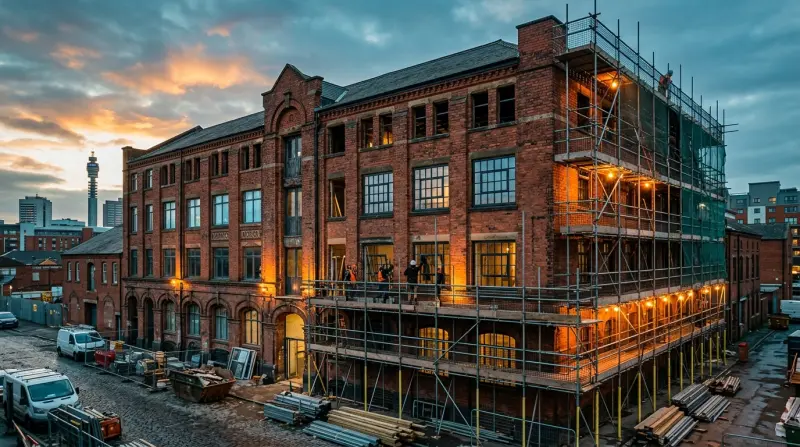
Birmingham's ongoing regeneration means development opportunities continue to emerge across the city region. From warehouse conversions in Digbeth and the Jewellery Quarter through to new-build schemes on brownfield sites in Eastside, developers need finance that matches the speed of planning and construction cycles.
Bridging finance supports the acquisition phase of development projects - purchasing the site or building before full development finance is arranged - and funds lighter refurbishment works that do not require a full development facility.
Common Birmingham refurbishment scenarios include:
- Cosmetic renovation of dated rental stock in Moseley, Kings Heath and Sparkhill to achieve higher yields
- HMO conversion of larger houses in Selly Oak, Edgbaston and Harborne
- Commercial-to-residential conversion under permitted development rights, particularly in secondary high-street locations
- EPC upgrades to bring older stock from Band E or F to Band C ahead of tightening regulatory thresholds
Our guide to exit strategies covers the most common routes for refurbishment deals.
Second Charge Facilities for Birmingham Portfolio Landlords
Birmingham portfolio landlords often hold significant equity across multiple properties. A second charge bridging loan releases that equity without disturbing existing mortgage arrangements - useful when the current first charge carries a below-market fixed rate that would be lost on a full refinance.
Common second charge use cases in Birmingham include:
- Funding auction deposits from equity in existing portfolio properties
- Covering refurbishment costs on a new acquisition without increasing the first charge
- Releasing capital for a business purpose, secured against an investment property
- Bridging between sale of one property and completion on another
Second charge completions generally take seven to fourteen working days because consent is required from the first charge lender.
Why Birmingham Investors Use Bridging
- Traditional mortgage declined due to property condition
- Auction purchase with a 28-day completion deadline
- Existing bridging facility approaching expiry and needing refinancing
- Commercial property opportunity that will not wait for bank timescales
- HMO conversion requiring upfront capital before the property generates income
- Portfolio restructuring where speed avoids losing favourable purchase terms
For time-critical deals, our guide to fast bridging loans explains how to prepare the application for the fastest possible completion.
Getting Started with a Birmingham Deal
Whether the property is an auction lot heading under the hammer at Bond Wolfe, a Digbeth warehouse suitable for residential conversion, a Selly Oak HMO conversion, or a Jewellery Quarter commercial acquisition, the first step is the same.
Mallard Bridging provides facilities from £25,250 to £40,000,000 for business and investment purposes across Birmingham and the whole of England and Wales. All costs are rolled into the gross loan, there are no exit fees, and a timely repayment discount is available for borrowers who repay on or before the agreed date.